
Laboratory operations platform
One chain of custody, from the clinic to the signed report.
LIMSTrack connects the people who order a test, the collectors who take the sample, and the laboratory that runs it — so every specimen carries its own history, and nothing is reconciled by email at the end of the week.
How it works
Built around the specimen, not the spreadsheet
Each role sees the step it owns, and every action is written to an audit trail that can be read back later without reconstructing it from memory.
Order
Providers order against a shared catalog, with diagnosis codes and collection instructions already attached.
Collect
Collectors work a scoped queue on a phone and capture the kit barcode at the point of collection.
Accession
Receiving reconciles what shipped against what arrived, so a specimen that never made it is caught on the dock.
Test
Plate layouts, control wells and instrument results stay attached to the run that produced them.
Release
Releasing freezes an immutable snapshot, so a report reprinted next year is the report that was signed.
Access you can account for
The controls sit in the query path rather than bolted on afterwards, so there is no route to the data that quietly skips them.
Tenant-scoped by default
Every request for clinical data is scoped to one organization on the server, never filtered in the browser.
Roles that mean something
What a person can see and sign follows the role they hold, down to individual screens and actions.
Logged access
Reads and writes against patient data are recorded, so the trail exists before anyone asks for it.
For clinics
Your practice system keeps ordering the way it already does
A clinic connects to a laboratory once. After that an order can arrive from the practice system itself rather than being retyped at both ends — and the result comes back to the same place the order came from.
Orders over an API
One intake endpoint per lab–clinic connection, authenticated with a key rather than a user login, so the practice system can post an order without anyone signing in.
Your codes, mapped once
The ordering system's own test codes map to the laboratory's catalog. Anything unmapped stops in a review queue to be resolved by a person, instead of being guessed at.
Standards on the result
LOINC and SNOMED coding lives on the test definition, so a released result carries the codes the systems downstream of you expect to read.
Safe to retry
Resubmitting an order returns the one that already exists, so an interface that retries after a timeout cannot quietly create a second specimen.
HL7 v2 and FHIR in progress
The intake payload is deliberately format-neutral, so each feed becomes an adapter onto the same endpoint rather than a second integration to maintain.
Or no integration at all
A clinic can order in the browser, follow the specimen through collection and the lab, and read the signed report — without writing a line of code.
Screens
A look at the application
A few screens from the working system, captured with synthetic demonstration data.
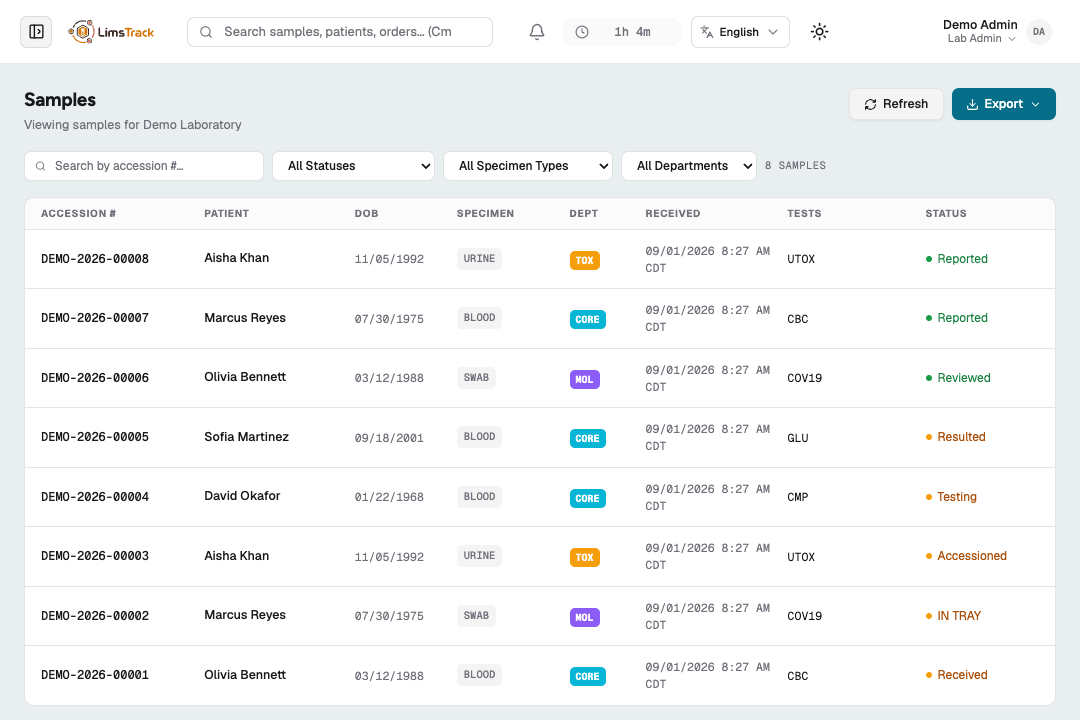
Chain of custody
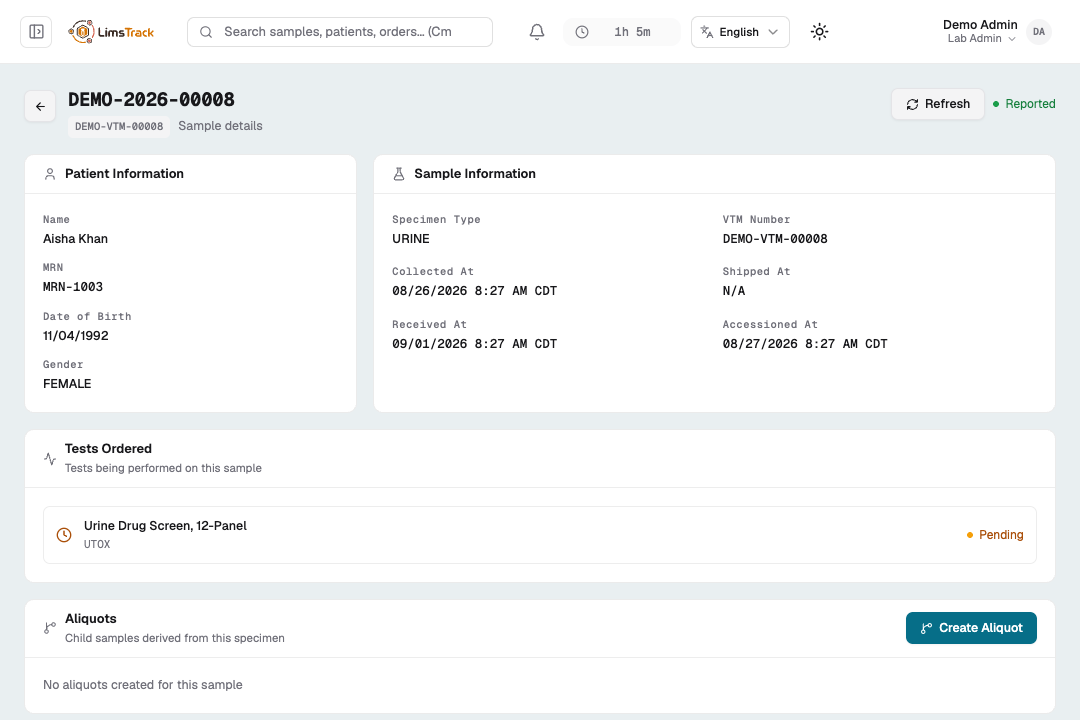
Collected, shipped, received, accessioned — each step timestamped against the kit that carried the specimen.
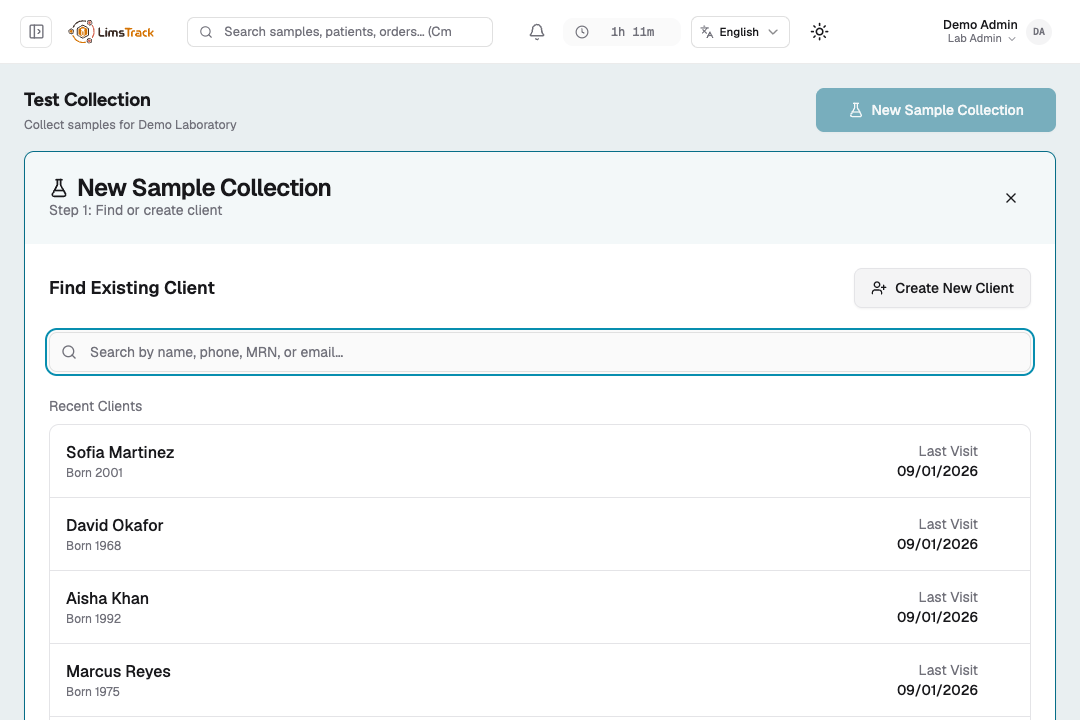
Collection in the field
A guided flow for the person taking the sample, so a required step cannot quietly be skipped.
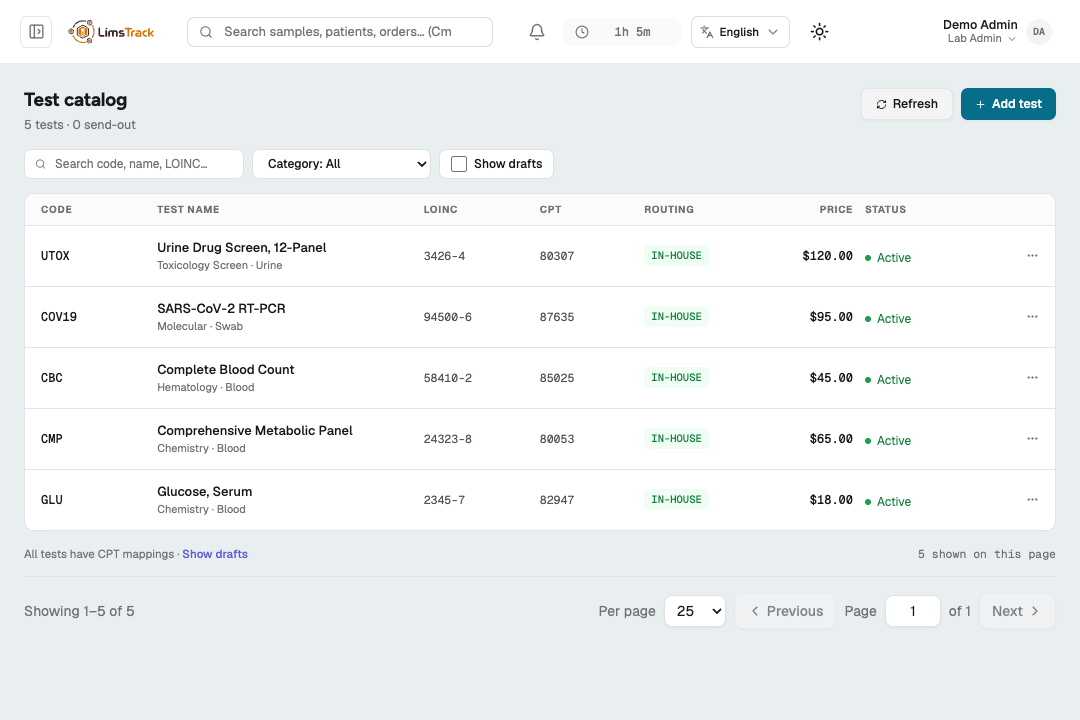
Test catalog
LOINC and CPT coding on every test, so results and claims leave the building correctly coded.
A specimen is only as good as the record that follows it.
If that record currently lives in a spreadsheet, a shared inbox and somebody's memory, that is the gap LIMSTrack was built to close.
Request a walkthroughGet in touch
Talk to us
Tell us about your laboratory or clinic and what you are running today. Messages go straight to the team — no queue, no sales sequence.
- A person reads every message and replies by email.
- Nothing is added to a mailing list.
- Please keep patient information out of the form.